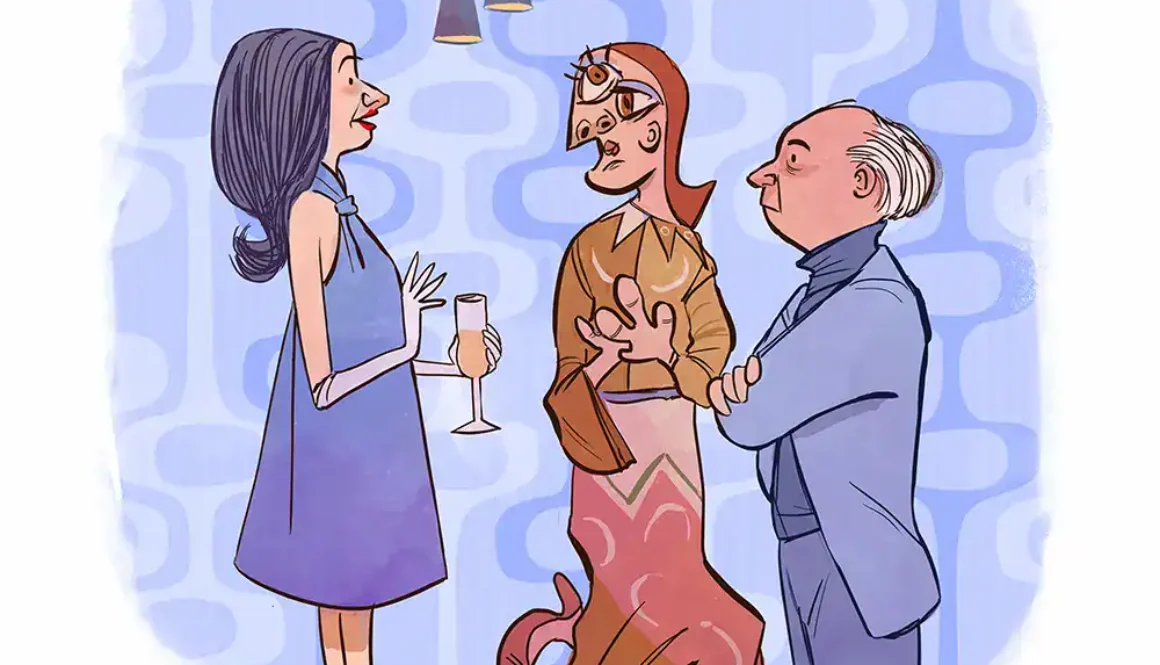
In this Singularities cartoon, a cocktail party introduction goes sideways when a guest meets Picasso’s wife and realizes she looks exactly like one of his Cubist portraits. Picasso stands by with his arms crossed, clearly unamused that his muse is also his punchline. It’s a Picasso cartoon for anyone who has ever stood in a gallery and wondered what the people in those paintings looked like at dinner.
Shag, retro futurism and our strange fixation on a past that keeps getting redrawn
Picture the scene, because you already know it by heart. A cocktail sweats in someone’s hand. A butterfly roof floats overhead, and a kidney-shaped pool glows in the background as if it were lit from underneath. Someone lights a cigarette. Someone else, judging by the sly expression, is probably having an affair. A tiki idol watches from the corner while a suspiciously well-dressed cat surveys the room from the sofa, and somewhere above the mountains a flying saucer hangs in the sky as if it paid rent there. Nobody in this painting looks even faintly concerned about any of it. Welcome to the mid-century, or more precisely, welcome to the mid-century the way we have collectively decided to remember it.
The Artists
The Artists Keeping the Party Going
Those cocktail lounges, jazz records, Googie coffee shops and Space Age fantasies are more than half a century old. Yet this visual language still refuses to fade. Contemporary artists keep borrowing its flattened shapes and exuberant color, along with its unwavering confidence that the future probably requires a martini. Audiences keep buying it, hanging it in their living rooms and building entire personal aesthetics on top of it.
Southern California painter and illustrator Shag, known offstage as Josh Agle, has become the most recognizable face of this revival, and he works in good company. Artists including Derek Yaniger, El Gato Gomez and Tim Biskup have each absorbed pieces of that earlier visual culture and reassembled them into something that belongs to the present. Meanwhile, artists from the original era, including Jim Flora, continue to shape illustrators who were not even born when his album covers first landed in record store bins.
Which raises an obvious question. Why this particular past, and why do artists keep circling back to it decade after decade? Most old visual trends eventually drift off to the thrift store and stay there, but this one keeps walking back through the front door. Hiding underneath that obvious question is a stranger one: why do people feel nostalgic for a world they never actually lived in?
Here is the first complication. The mid-century that shows up in contemporary art is not necessarily the mid-century that actually existed. It is a remix, carefully edited for content. The architecture stays, the swimming pool stays, the jazz stays and the cocktails absolutely stay. What disappears is the commute, the paperwork, the geopolitical anxiety and the social inequality, along with most of the ordinary Tuesday afternoons that made up the actual decade. What remains is not history so much as mythology.
That distinction matters, because artists working in this tradition generally are not producing documentary illustrations of postwar America. They are selecting fragments of its visual vocabulary and using them to build something new, and Shag makes that point unusually explicit. His official biography describes his lavish, retro-tinged interiors as little more than window dressing or stage scenery. He cares far more about the stories happening inside the paintings, and about whatever meaning a viewer finds there. The cocktail lounge, in other words, is not the subject. It is where Shag puts the subject, the way a set designer might build a stage for a play nobody has written yet. That is also why calling this work merely “retro” undersells it. The past supplies the props. The artist writes the play.
Everybody Has a Martini, Nobody Has a Mortgage
Spend enough time with mid-century-inspired art, and you may start wondering whether anyone in this universe holds down a job. Figures lounge, flirt and throw parties beside swimming pools in houses that today would list for an alarming number of zeroes. None of this happens by accident. Artists working in this tradition have extracted one of the most seductive ingredients of postwar advertising: leisure itself.
Advertising and illustration back then rarely sold people a plain product. They sold the life the product supposedly unlocked. A house was never only a house; it represented modern living. A cocktail was never only a drink; it signaled sophistication. A hi-fi set was never only an appliance, because it meant you belonged to the kind of household where attractive strangers turned up in the living room while a jazz record spun somewhere in the background.
Contemporary artists inherit that visual vocabulary without having to believe the sales pitch behind it, and the gap between the imagery and the illusion is exactly where they start having fun. Shag’s paintings turn especially interesting here. Their glossy surface often hides something murkier underneath, with excess, temptation and tangled relationships playing out as human beings behave badly in gorgeous rooms. The party looks fun. Something, though, always seems to be happening at the party.
The past supplies the props. The artist writes the play.
The Lineage
Flat People, Big Personalities
Then there is the way this world gets drawn in the first place. Much of the mid-century visual vocabulary abandoned the idea that an illustration needed to resemble a photograph. Shapes flattened out, perspective bent into odd new angles, and backgrounds often vanished altogether. A nose could collapse into a triangle. A hand could reduce itself to a handful of confident lines, and a musician could nearly dissolve into pure rhythm, all elbows and sound.
That visual economy spread across commercial illustration, advertising, animation, album covers and graphic design throughout the era. Few artists pushed it with more unhinged energy than Jim Flora. His jazz album covers for Columbia and RCA Victor detonated with impossible bodies, sharp geometry and visual syncopation, and his musicians ended up looking less like people playing music than like the music itself had grown arms and legs.
His influence did not end when the records went out of print. Tim Biskup has described standing in a record store, holding a copy of Shorty Rogers Courts the Count, and realizing on the spot that the cover would change the way he drew for good. Gary Baseman has called Flora’s covers visual jazz, playful and improvisational in a way few illustrators before or since have matched. That is how a visual language actually survives. It lives on through mutation in somebody else’s sketchbook rather than through preservation in a museum case.
This is where the story grows bigger than contemporary retro art alone. Artists never really work in a vacuum, and the mid-century visual vocabulary grew out of a collision between modern art, illustration, animation, advertising and architecture. Those influences kept traveling forward long after the era that produced them had ended. Sometimes an artist can trace the lineage precisely, but more often they cannot.
One artist stumbles on an old record cover in a thrift store. Another discovers a box of vintage advertising illustrations at an estate sale. A third grew up watching cartoons whose designers had absorbed modern art without ever naming their sources out loud. The influence travels from Picasso and Miró into graphic design, and from graphic design into animation. From animation it moves into somebody’s childhood memory, and from childhood memory into a painting hanging in a gallery today. By the time it arrives, nobody is copying 1955 anymore. They are responding to generations of people who spent decades responding to 1955 first, and that layering is how an aesthetic eventually becomes a language, complete with its own grammar and its own inside jokes.
The Screen
Saturday Morning Was an Art School
That third artist, the kid parked in front of the television, may be the most important link in the entire chain. Long before most of us ever heard the name Jim Flora, we had already absorbed his visual grammar through cartoons. The handoff traces back to the early 1940s, when several artists left Disney in the wake of its 1941 strike and went on to build United Productions of America, better known as UPA. The new studio wanted animation to look like modern art rather than a storybook come to life. Its 1950 short Gerald McBoing-Boing, about a little boy who speaks only in sound effects, used flat color, sparse backgrounds and bold graphic shapes that owed more to modern painting than to Bambi. It won the Academy Award, and suddenly every studio in town wanted to look modern.
Disney absorbed the lesson through Mary Blair, whose concept art for Cinderella, Alice in Wonderland and Peter Pan pushed the studio toward daring color and simplified shapes, and who later designed the look of “it’s a small world.” By the end of the decade, Eyvind Earle had given Sleeping Beauty its razor-sharp, stylized forests. Over at Warner Bros., layout artist Maurice Noble built angular, candy-colored alien landscapes for Chuck Jones. Their 1953 short Duck Dodgers in the 24½th Century remains one of the purest pieces of retro futurism ever put on film, even though nobody at the time would have called it retro anything. As far as its audience knew, it was the future.
Then in 1962, Hanna-Barbera beamed the Space Age straight into American living rooms with The Jetsons, a prime-time family comedy set among Googie towers and flying cars. For the kids who caught it in reruns for decades afterward, that show became their first memory of tomorrow. It also turned into one of the richest sources of the borrowed nostalgia we will get to in a moment, because an entire generation learned what “the future” looked like from a cartoon made before they were born.
The line kept running. In the 1990s, a new crop of CalArts-trained animators brought the UPA look roaring back on Cartoon Network, as Genndy Tartakovsky’s Dexter’s Laboratory and Craig McCracken’s The Powerpuff Girls built whole shows out of flat color, hard angles and mid-century graphic design. Tartakovsky pushed that approach even further with Samurai Jack, and Pixar followed in 2004 with The Incredibles, a superhero film that looks like a 1960s spy thriller filtered through a Palm Springs architecture tour. For plenty of today’s retro artists and their fans, these shows were the real art school. They learned the vocabulary on a Saturday morning, cereal bowl in hand, years before anyone taught them the word “modernism.”
The Revival
Derek Yaniger Is Still at the Cocktail Party
Derek Yaniger embraces the retro universe without much apology. His own bio describes work drawing inspiration from tiki, beatnik culture, jazz, rockabilly, burlesque and cocktail culture, and those influences announce themselves instantly through his angular characters, restrained palettes and kinetic graphic shapes. Tiki alone carries a lineage worth its own article. The fantasy of a Polynesian escape took root in Hollywood in the 1930s at Don the Beachcomber’s bar, spread through postwar suburbs one backyard luau at a time, and landed at Disneyland in 1963 with the Enchanted Tiki Room. Like the rest of this mythology, it was an invented paradise from the start, which makes it perfect raw material for an artist with a sense of humor.
Yet Yaniger’s work never feels like someone recreating an old ad for a cocktail brand that vanished decades ago. It carries too much personality of its own for that, because Yaniger takes the old vocabulary and speaks it in his own accent. That distinction turns out to matter for this entire conversation. Revival art becomes interesting the moment it stops functioning as imitation. A reproduction asks how someone drew a thing back then, while a contemporary artist asks what he can do with that same vocabulary right now.
Then things get delightfully strange. El Gato Gomez works in the language of retro futurism. Her paintings, as one profile puts it, mix sleek mid-century homes and cocktail-era glamour with sci-fi cars and flying saucers, and a small standing army of cats often crowds into the very same canvas.
That contradiction sits right at the center of retro futurism as a genre. We are looking backward at people who spent their whole careers looking forward, which means the future on display never actually happened. Somehow we manage to miss it anyway, the way you might miss a vacation you never took because the brochure looked so convincing.
Tim Biskup demonstrates why nobody should treat this as one tidy retro-art movement with a single set of rules. His work has moved through abstraction, figurative painting, sculpture and graphic experimentation over the years. Yet earlier visual influences, Flora chief among them, still run somewhere underneath the surface.
That is useful, because it shows what influence actually looks like in practice. Loving a 1950s album cover as a teenager does not obligate anyone to spend an entire career painting cocktail lounges. Influence can go structural instead, living on in shape, rhythm, composition and attitude long after the source material has become nearly invisible to the naked eye. The DNA stays behind even after the recognizable image itself has disappeared.
Which brings us back to Shag. Josh Agle’s paintings offer some of the clearest evidence anywhere of how mid-century imagery can turn into something contemporary rather than merely nostalgic. His characters inhabit spectacular environments crowded with architecture, cocktails, fashion and consumer objects, and his paintings have traveled to exhibitions around the world. The Shag Store in Palm Springs plants the work inside one of the great surviving strongholds of mid-century American culture.
Yet the paintings never just ask you to wish it were 1960 again. They run on narrative from top to bottom. Something has already happened, and something else is about to. Someone in the painting clearly knows something the others do not, and someone probably should not be standing quite that close to someone else. The viewer always seems to arrive in the middle of the scene, several drinks and one significant glance too late to have caught the beginning.
That narrative pull may explain why these paintings reward long, slow looking. A glance on the way past will not do. You do not just register the style and move on, because you start inventing the story yourself, whether Shag intended you to or not.
Now for the truly strange part. Plenty of people who love this imagery were not alive when the original visual culture existed in the first place. Researchers call that broader phenomenon historical nostalgia, and the internet has given it a prettier name, anemoia, a word coined by writer John Koenig for his Dictionary of Obscure Sorrows. Personal nostalgia is the feeling that arrives when a song from your own childhood comes on the radio. Historical nostalgia works differently, involving emotional attachment to a period entirely outside your own lived experience.
In other words, you can miss a party you never actually attended. Researchers who study this have found that nostalgia runs far more complicated than sentimental longing. A widely cited study links nostalgic reflection to meaning and social connectedness, among other psychological functions people rarely associate with the word at all. More recent research has specifically examined younger audiences who feel real nostalgia for periods they never personally lived through, and the feeling turns out to be far more common than you might guess.
That matters quite a bit here. Someone born decades after the cocktail lounge’s heyday does not need an autobiographical memory of 1962, because culture happily supplies the memory instead. Movies and old photographs supply it, Jetsons reruns supply it, and so do music, advertising and, yes, artists like Shag. Eventually an imagined past becomes emotionally meaningful even to people who never experienced a single second of it. The feeling is no less real for being borrowed.
The Past Looks Amazing Once You Remove the Boring Parts
Historical nostalgia carries one real advantage over actual memory: you get to edit. Nobody has to feel nostalgic for an entire decade in its unedited entirety. We can keep Saul Bass title sequences, the jazz, the architecture and the general optimism about technology, and all the while we can quietly lose everything nobody particularly wants to bring back.
That selective process is exactly why we should stay cautious about treating retro imagery as history. It functions much closer to cultural collage. Contemporary artists are not necessarily telling us what the mid-century actually was. They are telling us which parts of it still feel useful to borrow today, and that ongoing negotiation is probably why this imagery keeps mutating instead of quietly disappearing like most old visual trends.
You can miss a party you never actually attended.
The Future
Maybe We Don’t Miss the Past. Maybe We Miss Its Future.
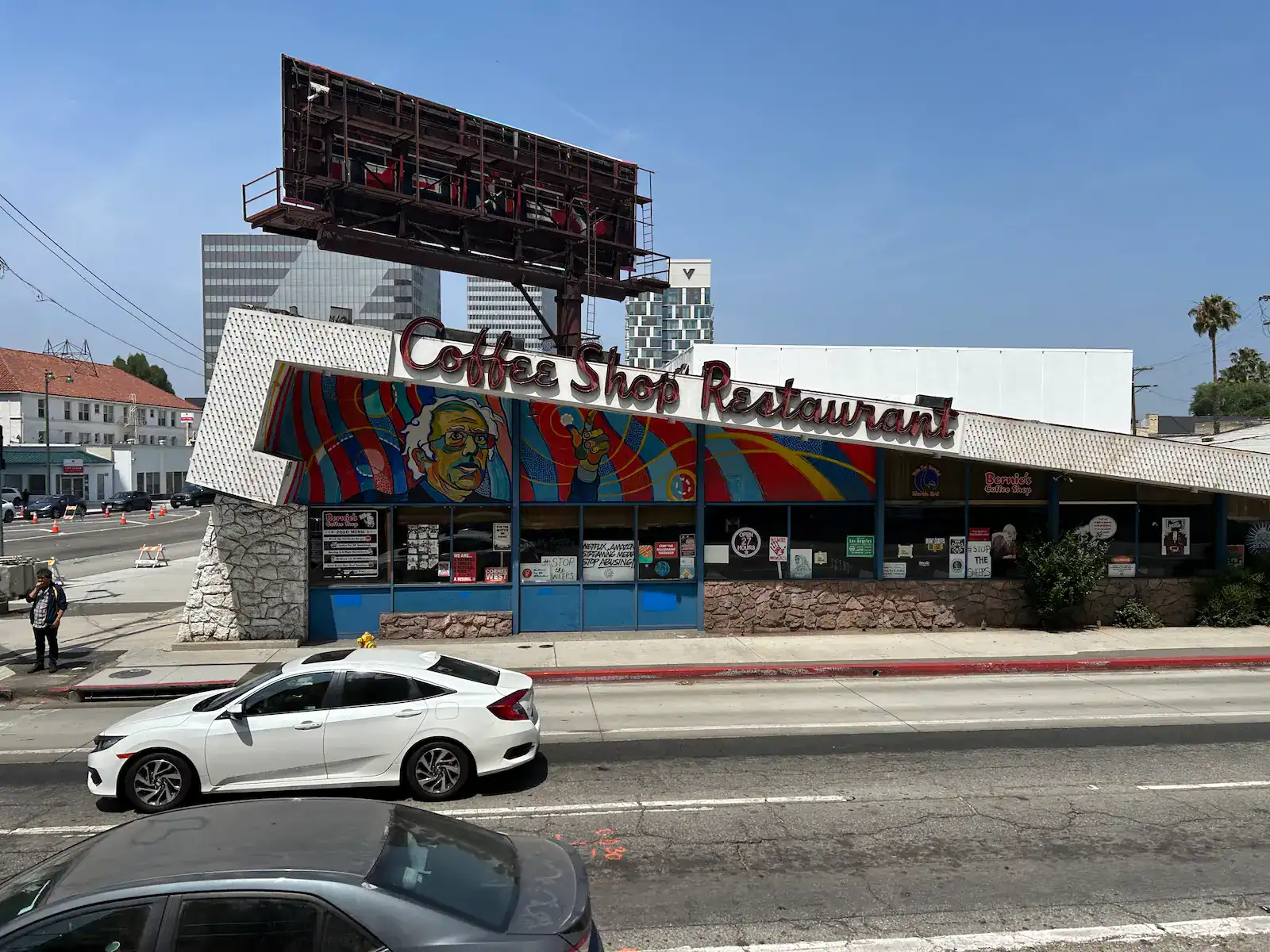
One last irony hides inside all of this. Much of the imagery we now file under nostalgic was never looking backward to begin with. It was obsessed with tomorrow, fed by jet travel, atomic energy, television, synthetic materials and space exploration, along with cars styled like rockets and buildings styled like launch pads. Googie architecture pushed that fantasy hardest of all, turning ordinary coffee shops and gas stations into miniature monuments to an imminent future. Mid-century visual culture imagined tomorrow so enthusiastically that even the local diner started looking like it might achieve orbit.
Johnie’s Coffee Shop at Wilshire and Fairfax, designed by Armét & Davis in 1956 and later repainted as “Bernie’s Coffee Shop.” Photo via Wikimedia Commons (public domain).
Now we look back at those old visions of tomorrow and feel nostalgic for them anyway. We have become nostalgic, in effect, for someone else’s future rather than for our own past. That peculiar twist may explain why contemporary artists cannot seem to leave this era alone, as each of them takes pieces of an older visual language and reassembles them into something that belongs to them.
That is what artists have always done, generation after generation. They borrow from the past, reinvent it for the present and hand the whole thing back to us as something new. Mid-century modern art may refuse to disappear for a precise reason: it was never really about remembering the world as it actually was. It remembers the world as somebody once hoped it might become. Evidently, we are still not finished looking at that particular future.